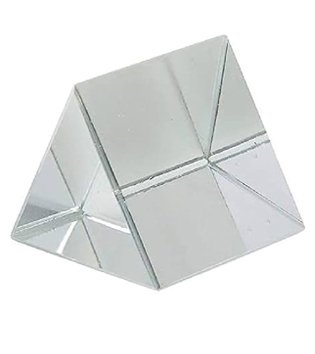
A Glass Prism is a transparent optical element with flat polished surfaces that refract light. It is one of the most fundamental tools in the study of optics and the properties of light. The classic triangular prism with two triangular bases and three rectangular faces is designed to perform two primary functions: dispersion and deviation. When white light enters a prism the difference in refractive index for different wavelengths causes the light to separate into its constituent colors (the spectrum) a process known as dispersion. Furthermore the prism deviates (bends) the light path making it ideal for experiments measuring the angle of deviation and the refractive index of the glass material itself. Prisms are indispensable for demonstrating the nature of visible light and the laws of refraction.
Dispersion of Light: Provides a classic and clear demonstration of dispersion splitting incident white light into the visible spectrum of colors (rainbow effect).
Refraction Study: Used to accurately measure the angle of minimum deviation and apply Snells Law to determine the refractive index of the prism material.
High Optical Clarity: Manufactured from high quality optical glass (such as crown or flint glass) with precisely polished faces for minimum light scattering and distortion.
Deviation Control: The prism geometry allows for predictable bending (deviation) of the light path essential for steering light in more complex optical setups.
Versatile Shapes: Available in various geometric shapes most commonly the equilateral triangle but also right angle trapezoidal and other forms for specific applications like total internal reflection.
Apparatus Type: Solid, transparent optical element.
Material: High quality Optical Glass (Crown glass is common).
Shape: Typically an Equilateral Prism with a base angle of 60 degrees.
Surfaces: Three flat, highly polished, and precisely angled surfaces.
Application: Used for light dispersion, measuring refractive index, angle of deviation, and demonstrating total internal reflection.